Why 2026 is the Year of “Invisible AI” (and the Hardware Making it Happen)
Time to read: 10 mins
For the past two years, the enterprise world has been caught in a fever dream of generative AI.
Silicon Valley keynotes promise a corporate setting where AI assists our daily work tasks and writes our emails.
But as we move through 2026, the atmospheric pressure in the boardroom has changed. The “tourist phase” of AI is over. The novelty has worn off, and the CFO is asking a pointed, uncomfortable question: Where is the ROI?
The answer isn’t found in a sleeker LLM or a more creative image generator. It is found in the basement—specifically, in the silicon and copper that underpin the modern data centre.
If 2024 was the year of AI experimentation, 2026 is the year of “Invisible AI”: the high-stakes, high-reliability automation of core business logic. For the IT leaders tasked with making this shift, the IBM Power 11 has emerged not just as a server, but as the definitive foundation for this new era.
THE TREND
The Death of the “Science Experiment”
In the early 2020s, AI was a ‘destination’—an interface you visited to ask a question. In 2026, the most successful AI is the AI you don’t see. It is the fraud detection algorithm that clears a transaction in 10 milliseconds; it is the supply chain model that reroutes a shipping container before a port strike even hits the news; it is the healthcare database that flags a drug interaction as the doctor is typing the prescription.
This is what you might call Inference-at-Scale, and it is fundamentally different from the “Training” phase that dominated the headlines during the GPU gold rush.
Training an AI model is like writing a book; it takes massive, brute-force power and months of time.
But Inference—running the finished AI model in real-time against live production data—is like using that book to answer a question in a split second. Many enterprises have spent thousands if not millions on the “writing” part. Now, they are realising their existing infrastructure is too slow and too disconnected to handle the “reading” part at the speed of a global business.
IBM Power 11: The Architecture of the “Day 2” AI
While commodity servers struggle with the “IO bottleneck” (the delay caused by moving data from the storage disk to the processor) IBM Power 11 treats data movement as a first-class citizen.
At the heart of this shift are the Matrix Math Accelerators (MMA). Unlike traditional chips that require a separate “math co-processor” to handle AI calculations, the Power 11 has these accelerators baked directly into every single core. This means your AI isn’t sitting in a separate “AI silo” in the cloud; it is sitting inside your core database.
When your AI is integrated into the silicon, the latency disappears. You are no longer “sending data to the AI”; the AI is a native part of your data’s home. This is the difference between a system that “supports” AI and a system that is built for it.
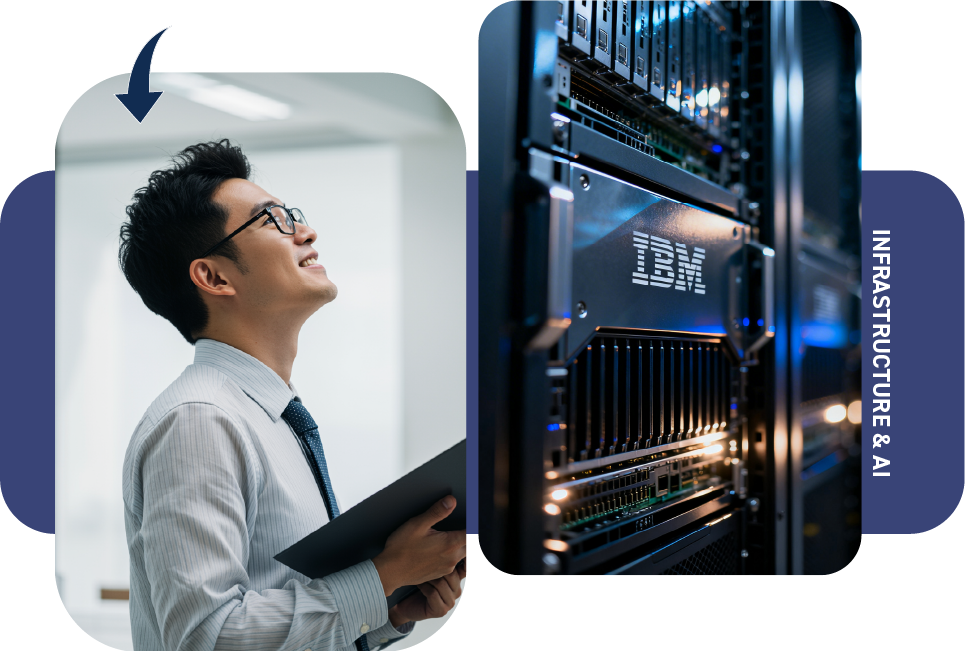
The Spyre in the Machine: Scaling Without Friction
For years, the dominant way to scale AI was to buy increasingly power-hungry GPUs. But modern GPUs have become the ‘Swiss Army Knives’ of parallel compute – packed with expensive, high-wattage hardware for graphics and complex mathematics that enterprise AI simply doesn’t require.
The Spyre Accelerator is a surgical specialist. As a 75W PCIe card purpose-built solely for AI, it provides the massive throughput required for Large Language Models (LLMs) and complex Retrieval-Augmented Generation (RAG) by focusing only on the specific calculations they need, without the astronomical power bill or the cooling nightmares of a traditional GPU farm.
In a CSI “Reality Check,” we look at the numbers: Imagine a global bank processing millions of documents to ensure regulatory compliance. On a standard x86 cluster, the latency of moving those documents to an external AI cloud creates a backlog that could take days to clear. With IBM Power 11 and Spyre, that same bank can ingest and analyse 8 million documents in a single hour, all while keeping the data behind their own firewall.
This isn’t just a performance boost; it’s a total reimagining of what “business at the speed of thought” looks like.
Why “Private AI” Wins
There is a growing tension in the AI narrative of 2026: the conflict between Innovation and Sovereignty. As AI models become more powerful, they also become hungrier for proprietary data. If you feed your company’s confidential data (your customer lists, your patents, your pricing strategies) into a AI cloud to get an answer, you have risk exporting your intellectual property into the public domain.
The IBM Power 11 foundation allows for privatised AI. It enables a company to run its own tuned models on its own hardware, governed by its own security protocols. This “Infrastructure-First” approach to AI turns the data centre into a fortress of intelligence.
At CSI, we call this the “Different Conversation.” We aren’t talking about how to make a chatbot more polite; we’re talking about how to build an infrastructure that ensures your AI strategy doesn’t become a data leak.
An AI Roadmap for the Pragmatic Leader
So, how does an IT buyer navigate this shift? The AI winners of 2026 will be the ones with the most resilient foundations.
- Stop the Silos: Move away from the idea that AI needs its own separate “experimental” hardware. Use Power 11 to consolidate your mission-critical ERP and your AI workloads into a single, high-bandwidth environment
- Focus on Inference: Shift your budget from “Training” to “Deployment.” The value of AI is in the answer, not the process.
- Prioritise Energy Intelligence: In an era of rising energy costs and ESG mandates, the 2x performance-per-watt advantage of IBM Power 11 isn’t just a “nice-to-have”—it’s a survival requirement.
Recapping the Year of “Invisible” AI
The “Invisible AI” of 2026 is quiet, efficient, and devastatingly effective. It doesn’t make headlines because it simply works— in the background, AI is performing tasks like loans approvals, energy or resource optimisation, and securing supply chains.
But behind that invisibility is a very visible piece of engineering. IBM Power 11 has moved the AI conversation from the laboratory to the ledger. It has proven that while software gets the glory, it is the infrastructure that provides the power.
Ready to build your foundation?
At CSI, we specialise in moving companies beyond the POC and into production-ready AI.
Schedule an Infrastructure Discovery Workshop and discover how an IBM Power 11 migration could reduce your AI latency by up to 40%? Message us here to find out more.
About the author


IBM Power
Is Infrastructure the Most Important Buying Decision?
MYTH BUSTING The Cost-Optimisation Paradox One of the most pervasive myths we encounter with customers is the idea that an…

IBM Power
Is an Infrastructure Refresh Right for You?
A DIFFERENT ANGLE The Sunk Cost Fallacy Rewind to the dusty server room of a mid-sized e-commerce company, let’s call…

IBM Power
Infrastructure In Focus
In an era defined by “cloud-first” mandates and AI adoption hype, the foundation of the modern enterprise—the infrastructure level—is often…
Ready to talk?
Get in touch today to discuss your IT challenges and goals. No matter what’s happening in your IT environment right now, discover how our experts can help your business discover its competitive edge.